
How our Network Penetration Tests Work
By Oakstone Security Group
September 20, 2026
Oakstone Security Group conducts penetration tests across web applications, external infrastructure, and internal networks. For network assessments, our objective is to determine what an attacker could actually accomplish after gaining access to your environment.
Different Types of Pentests
A network penetration test can be structured around several different threat scenarios.
A web application test evaluates a given web application for vulnerabilities such as SQL injection (SQLi), Cross-Site Scripting (XSS), Remote Code Execution (RCE), and more. These tests take the perspective of an unauthenticated web user, a low privileged user, and/or an administrative user.
An external network test on the other hand, evaluates any of your systems that an attacker can reach from the internet, such as web servers, VPN concentrators, or databases. An external test is meant to evaluate permiter security in order to understand what information exposure exists and is publicly availiable to a remote attacker.
Alternatively, an internal network test examines what an attacker could do after breaching the permitter and gaining access to your internal network. This could also replicate an attacker simply connecting to your Wi-Fi from the lobby.
Internal testing is particularly useful because it models scenarios that perimeter defenses alone cannot address. This may include an assumed breach, a compromised employee account or workstation, or a malicious insider with legitimate network access. Essentially, an internal network pentest simulates what could happen after an attacker has already gained an initial foothold. These tests often provide significant time and cost savings since the initial foothold is ceded under the assumption that a motivated attacker can and will gain access to the environment. The test then seeks to answer the question of “what could an attacker accomplish” with this access.
We look for paths to sensitive systems, opportunities for lateral movement, privilege escalation, credential exposure, segmentation failures, and other weaknesses that could allow a relatively limited foothold to become a much larger compromise.
Benefits of a Network Pentest
A network penetration test can help organizations:
- Identify vulnerabilities that could be exploited after an initial compromise
- Test network segmentation and access controls
- Identify practical paths for lateral movement
- Evaluate the potential impact of compromised credentials or endpoints
- Identify exposed administrative interfaces and sensitive services
- Validate whether security controls actually prevent meaningful attack paths
- Provide prioritized recommendations for reducing risk
The value of an internal assessment is often found in the relationships between systems. A single vulnerable workstation may not be particularly significant on its own. If that workstation can be used to reach a domain controller, database, backup system, or other sensitive resource, the risk is substantially different.
Network Visualization
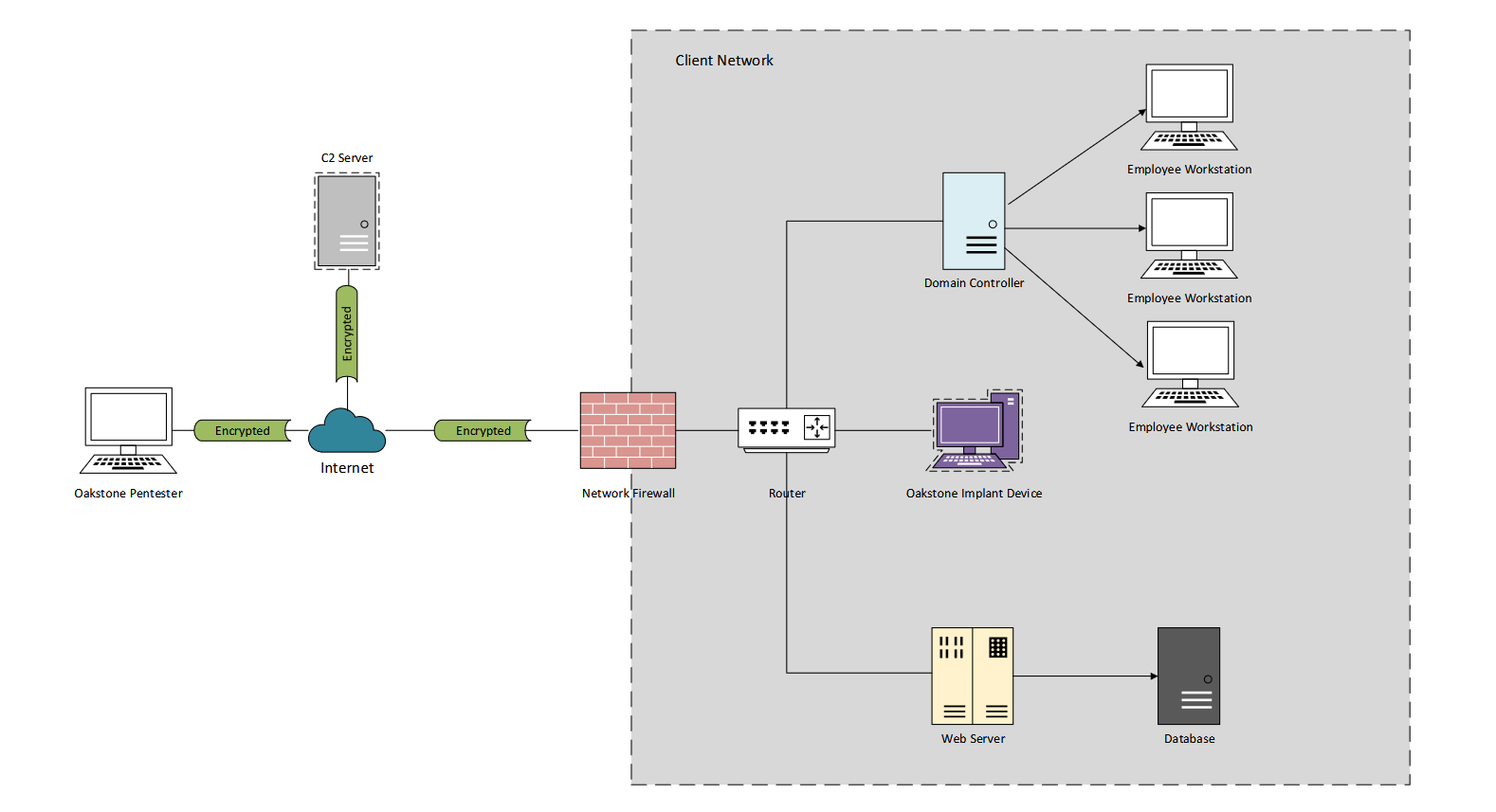
For many engagements, Oakstone provides a pre-configured assessment device that the client connects directly to their network via ethernet or Wi-Fi.
Once connected, the device establishes an outbound, encrypted connection to Oakstone’s command and control (C2) infrastructure. This gives our testers a controlled path into the environment without requiring the client to expose an inbound service or open additional ports on its firewall or network access control lists.
This approach is designed to minimize changes to the client’s existing network configuration while giving Oakstone the access necessary to conduct the assessment.
The device is configured before the engagement and remains under the client’s control while it is connected to the environment. Access is established only for the agreed testing period and scope.
For clients that prefer a different architecture, Oakstone can instead work through a dedicated virtual machine or testing workstation connected through the client’s existing VPN infrastructure. This approach can be appropriate where the client has specific internal security, compliance, or infrastructure requirements.
Regardless of the connection method, the objective is the same: provide our testers with an appropriate vantage point inside the environment without unnecessarily changing the client’s security architecture.
Why Oakstone
Oakstone approaches network penetration testing as an adversarial assessment rather than a vulnerability checklist.
We focus on real attack paths and patterns. We think and operate like a real-world attacker would in order to test your defenses and provide real reccomendations for improving your secrurity posture.
Our testing can be scoped to a specific network, segment, facility, or set of systems, with rules of engagement established before testing begins.
The result is a practical assessment of your network’s security posture, including the vulnerabilities that matter most and clear recommendations for addressing them.